
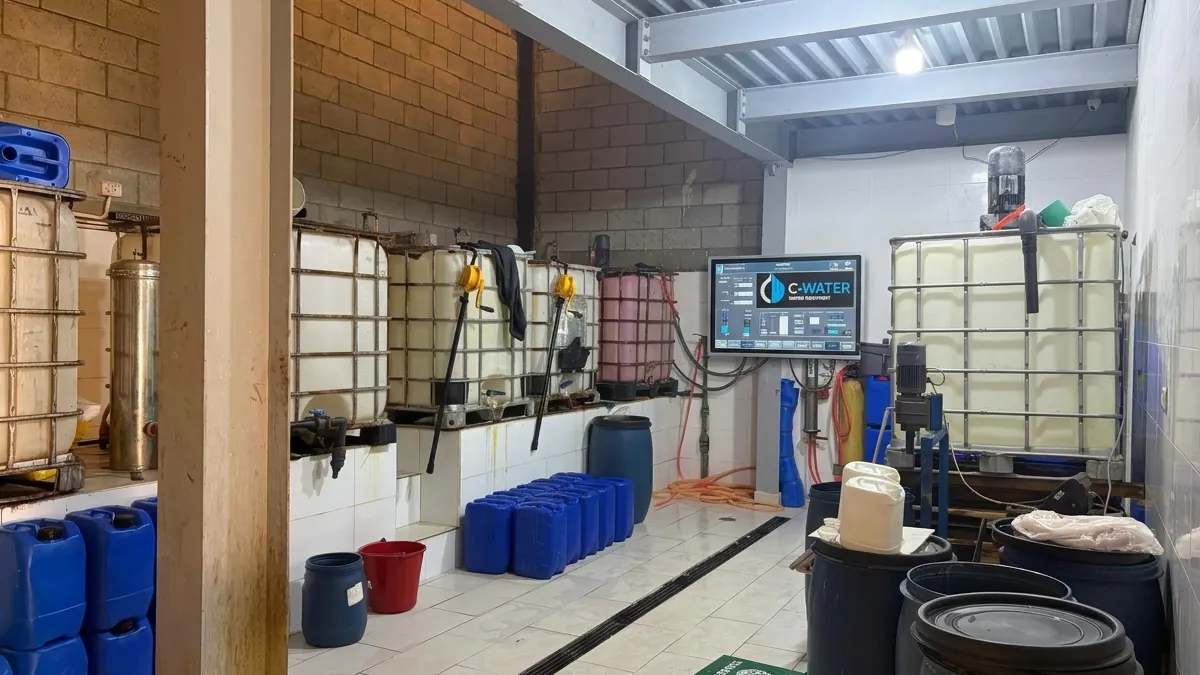
Food & Beverage · Wastewater
Letting Effluent Dosing Follow the Load
A treatment plant dosing for its worst day, every day, and what it takes to change that safely.
- Industry
- Food & Beverage
- Application
- Wastewater
- Location
- Illustrative — no site identified
Illustrative format example
This entry demonstrates the case-study structure. It is not a record of a specific C-Water project, and contains no customer names or performance figures.
01The challenge
What Was Wrong.
An effluent plant doses coagulant and polymer at a fixed rate set for the worst load the site produces. Most of the time the actual load is well below that, and the plant pays for the difference in chemical and in sludge.
02The existing system
What Was There.
Physical and chemical treatment with fixed-rate dosing. Load varies sharply between shifts, products and clean-down cycles. Discharge is sampled periodically for compliance.
03What C-Water did
The Approach.
- 01
Characterise the real load profile
Composite and grab sampling across the shifts, products and clean-down cycles that produce the peaks. The gap between the average and the peak is where the opportunity is.
- 02
Select chemistry by jar test
Coagulant and polymer chosen against the actual effluent rather than a general specification. Sludge volume and dewaterability are usually the largest running cost and are decided here.
- 03
Remove load mechanically first
Screening, separation and flotation take out load that would otherwise be treated chemically at higher cost further down the train.
- 04
Dose against a measurement
Feed driven by a measured load indicator lets consumption follow the plant. Compliance is maintained by monitoring the outcome, not by adding margin to the dose.
04What it addresses
The Outcome.
Consumption follows the plant
Dosing against a measured indicator means the plant stops paying continuously for a condition that occurs occasionally.
Sludge is treated as a cost
Chemistry selected with dewaterability in mind changes the largest running cost, not just the dose rate.
Compliance is monitored, not assumed
Continuous measurement at the discharge point provides both the evidence and an early warning that periodic sampling cannot.
The insight
Dosing for the worst case is a rational response to not knowing the load. The way out is not a braver dose rate — it is measuring the load.
Related Technologies
Related Products
Related Knowledge
Working Through a Similar Challenge?
Tell us what you are seeing and what has already been tried. We will start by establishing what is actually happening.