
Food & Beverage · Process Water
Deriving a Process Water Specification Instead of Inheriting One
What happens when a plant works out what its process actually requires from the water.
- Industry
- Food & Beverage
- Application
- Process Water
- Location
- Illustrative — no site identified
Illustrative format example
This entry demonstrates the case-study structure. It is not a record of a specific C-Water project, and contains no customer names or performance figures.
01The challenge
What Was Wrong.
A plant treats all process water to a single high standard because that is what the original specification said. Nobody currently working there knows where the specification came from or which process step it was written for.
02The existing system
What Was There.
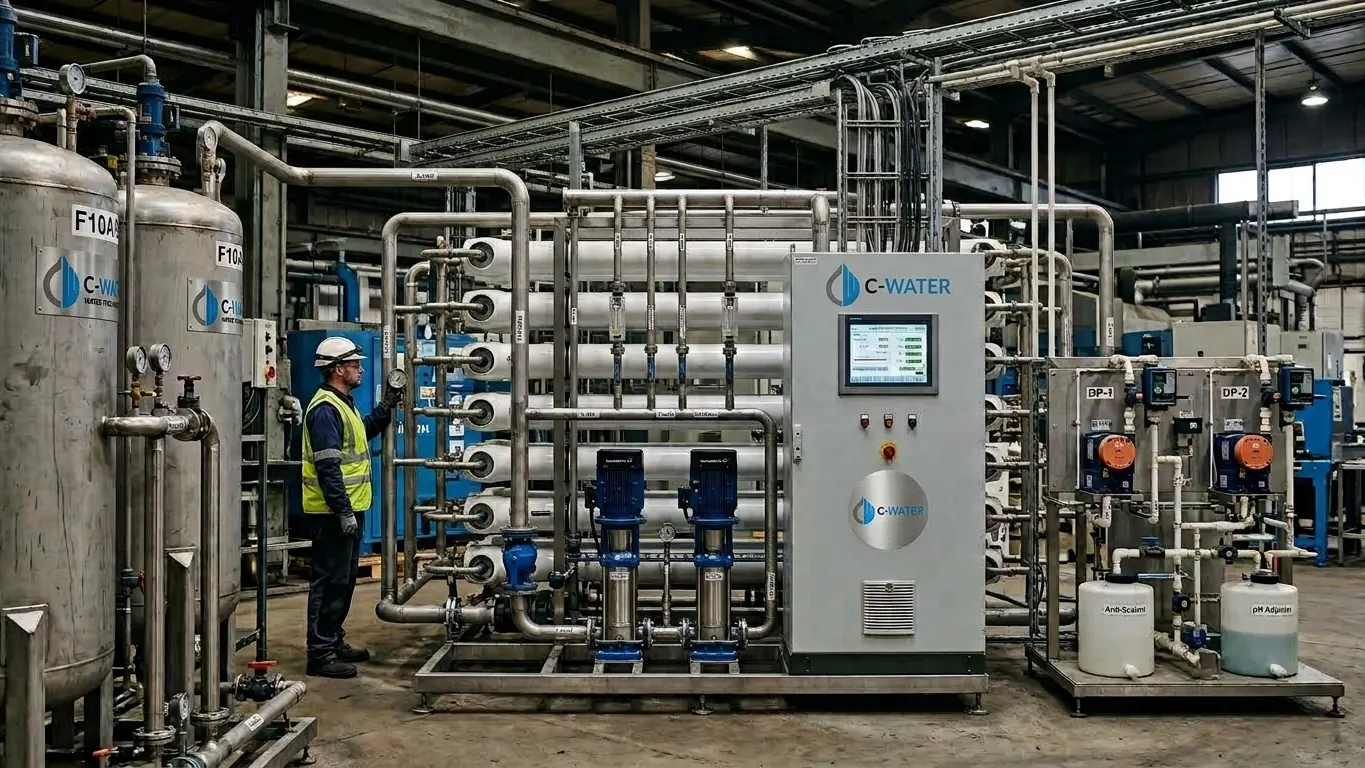
A single treatment train feeding several process uses with different requirements. Every litre is treated to the standard of the most demanding step, including the water used for the least demanding.
03What C-Water did
The Approach.
- 01
Map demand against requirement
Each point of use is listed with the parameters it genuinely cares about and the tolerance around each. This is usually the first time the site has seen that comparison written down.
- 02
Characterise the source across a year
A single sample on a good day describes a good day. The design has to hold across the range the supply actually delivers, including its seasonal worst.
- 03
Consider segregation
Where demands differ significantly, treating separate streams to separate standards can cost less to run than treating everything to the highest one.
- 04
Verify at the point of use
Online measurement at the point of use confirms the specification is being met when production needs it — not on average, and not at the plant outlet.
04What it addresses
The Outcome.
A specification that can be explained
Each requirement traces to a process reason, which makes it possible to review it when the process changes.
Over-treatment becomes visible
Treating to a higher standard than the process requires is a permanent operating cost, and it is invisible until the requirement is written down.
Verification where it counts
Measuring at the point of use rather than at the plant outlet is what turns a specification into evidence.
The insight
Inherited specifications are among the most expensive documents in a plant. They are rarely wrong in a way that causes a failure, which is exactly why nobody revisits them.
Related Technologies
Related Products
Related Knowledge
Working Through a Similar Challenge?
Tell us what you are seeing and what has already been tried. We will start by establishing what is actually happening.