
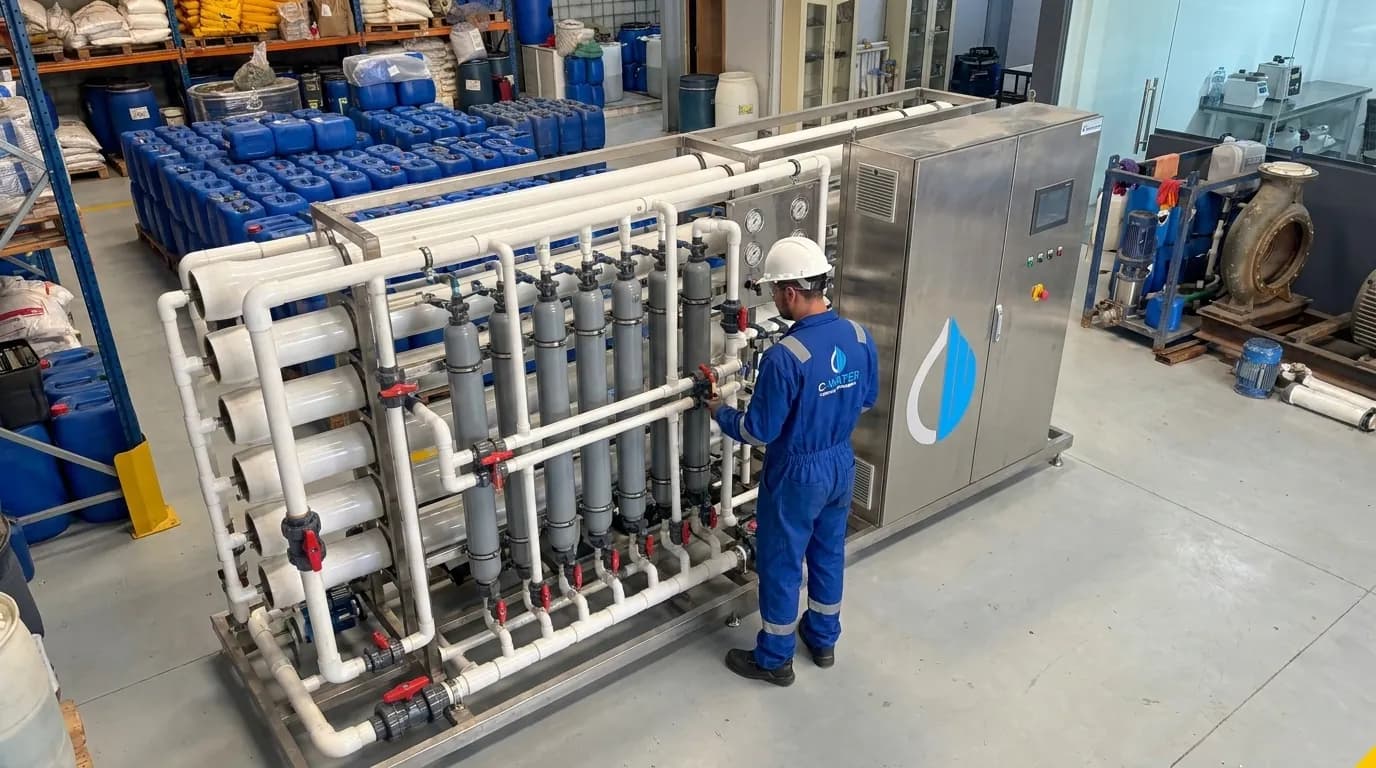
Reverse Osmosis & Membrane Treatment
Separation That Depends on Everything Before It.
A membrane is a very precise filter operating under pressure at the limits of what the feed water will tolerate. It is also unforgiving: most RO problems are not membrane problems, they are pretreatment problems that arrived at the membrane.
01What It Solves
The Problem It Addresses.
RO removes dissolved salts, and with them most of what makes a water unsuitable for a demanding process. The engineering question is not whether it works but at what recovery, at what energy cost, and for how long between cleans.
02How It Works
How It Actually Works.
- 01
Pretreatment sets the ceiling
Suspended solids, organics, oxidants and biological load all have to be dealt with before the membrane. SDI and turbidity at the feed point are the honest measures of whether that has been done.
- 02
Concentration at the tail
Recovery concentrates everything that does not pass the membrane into a shrinking reject stream. Scaling appears at the last elements first, which is why antiscalant selection follows the concentrate chemistry rather than the feed.
- 03
Fouling has a signature
Normalised data distinguishes the causes: rising differential pressure across a stage points to particulate or biological fouling, falling normalised flow with rising salt passage points to scaling. The cleaning chemistry follows the diagnosis.
- 04
Normalised performance
Raw readings move with temperature and feed pressure. Normalising to reference conditions is what reveals a genuine decline early, while a clean is still cheap and effective.
03Applications
Where It Is Used.
- Process water production
- Boiler feedwater preparation
- Brackish water desalination
- Wastewater recovery and reuse
Related Solutions
Related Products
Related Services
Related Knowledge
Is this the right technology for your system?
That question is answered by the water analysis and the operating conditions, not by a catalogue. Start there.