
Manufacturing · RO & Membranes
When the RO Problem Is Not the RO
Rising cleaning frequency is usually a pretreatment message. Reading it correctly is the whole exercise.
- Industry
- Manufacturing
- Application
- RO & Membranes
- Location
- Illustrative — no site identified
Illustrative format example
This entry demonstrates the case-study structure. It is not a record of a specific C-Water project, and contains no customer names or performance figures.
01The challenge
What Was Wrong.
An RO system is being cleaned far more often than it was designed to be. Each clean restores performance for a while, then the interval shortens again. Membrane replacement has been proposed.
02The existing system
What Was There.
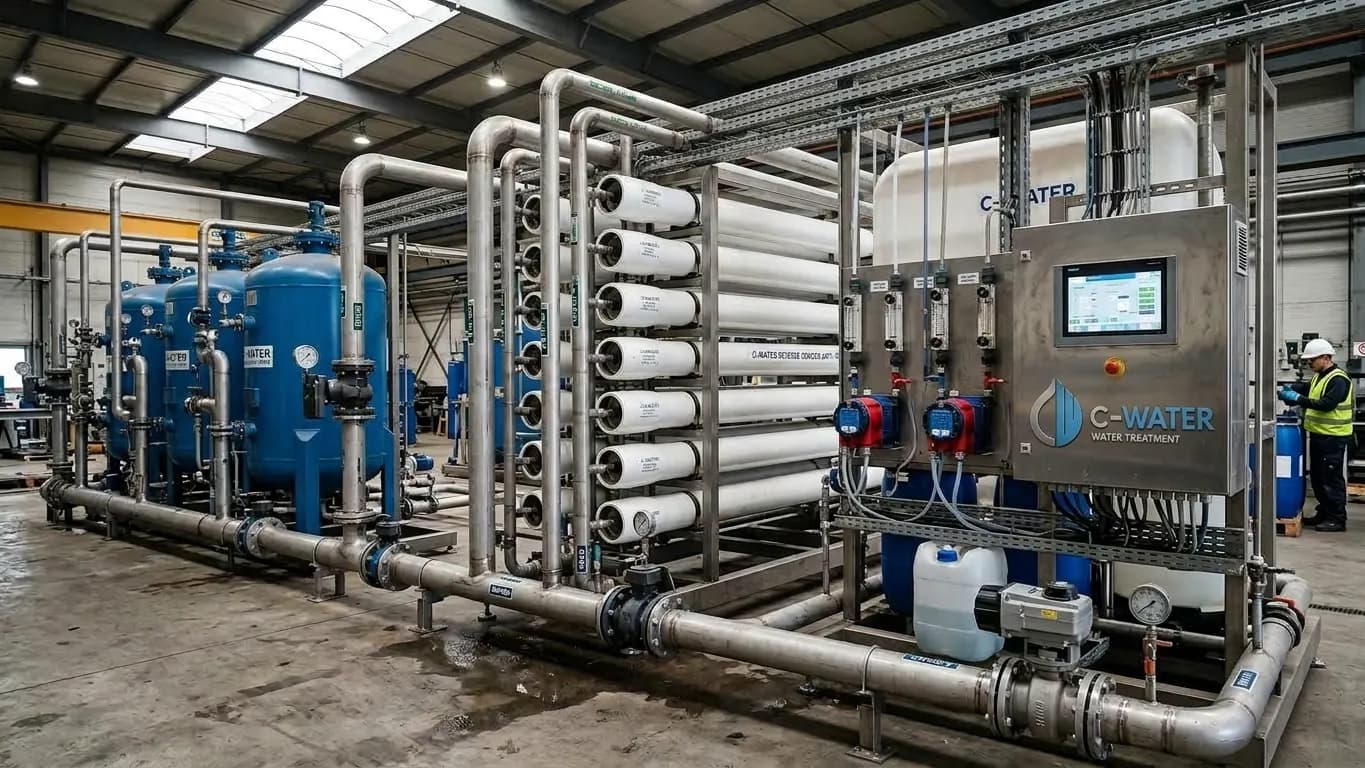
Multi-stage RO with media filtration and cartridge filtration upstream, antiscalant dosed at a fixed rate. Operating data is recorded as raw readings; nothing is normalised.
03What C-Water did
The Approach.
- 01
Normalise before diagnosing
Raw readings move with temperature and feed pressure. Normalised flow, salt passage and differential pressure separate a genuine decline from seasonal variation — and separate fouling from scaling.
- 02
Read the signature
Rising differential pressure across a stage points to particulate or biological fouling. Falling normalised flow with rising salt passage points to scaling. The two require different cleaning chemistry and different upstream fixes.
- 03
Measure what reaches the membrane
SDI and turbidity at the feed point are the honest measures of whether pretreatment is doing its job. Cartridge element life is a second, cheaper indicator that says the same thing.
- 04
Select against the concentrate
Antiscalant has to be chosen for the chemistry at the tail of the system at the intended recovery, not for the feed. Scaling appears at the last elements first for exactly this reason.
04What it addresses
The Outcome.
The mechanism is identified
Fouling and scaling look similar from the control room and are addressed completely differently. Normalised data is what tells them apart.
The fix moves upstream
Where the diagnosis points to pretreatment, replacing membranes treats the symptom and leaves the cause in place to do the same thing again.
Decline is caught earlier
Normalised trending reveals a real decline while a clean is still cheap and effective, rather than after recovery has already been reduced to compensate.
The insight
Most RO problems are not membrane problems. They are pretreatment problems that arrived at the membrane, and the membrane is simply where they became visible.
Related Technologies
Related Products
Related Knowledge
Working Through a Similar Challenge?
Tell us what you are seeing and what has already been tried. We will start by establishing what is actually happening.